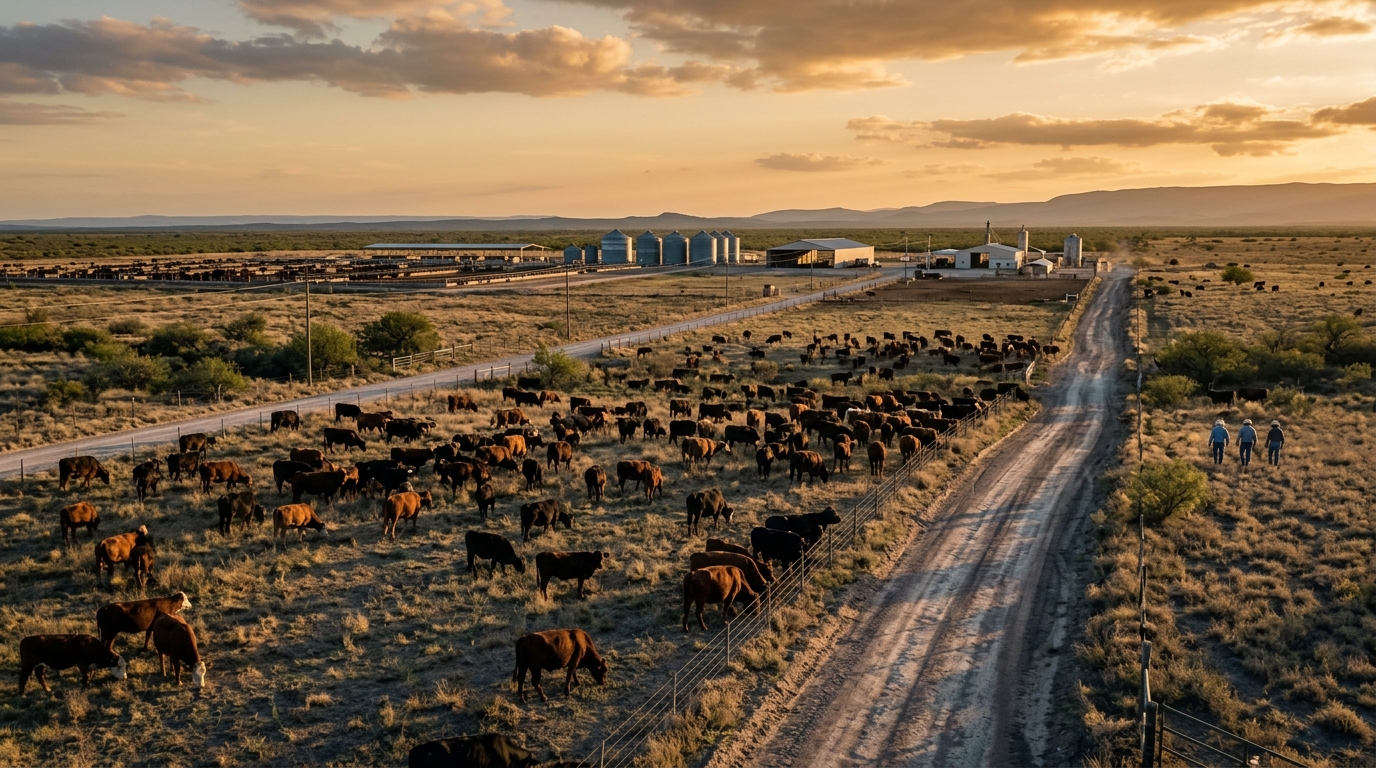
The Autonomous University of Tamaulipas (UAT) and the Regional Livestock Union of Tamaulipas (UGRT) signed an agreement on August 29 to modernize the state's livestock sector, with Governor Américo Villarreal Anaya serving as honorary witness, as reported by Milenio. The accord was sealed during the Unity Cavalcade, which brought together more than two thousand participants.
The agreement brings together the research and operational capacities of academia and the productive sector: the UAT's Faculty of Veterinary Medicine and Zootechnics will link its feed plants with producers affiliated to the UGRT, while students and faculty will carry out professional internships and research stays in the field. The alliance is part of the Carne Tam project, promoted by the UAT, the state government, and ranchers, which aims to leave behind the live-cattle export model and move toward meat industrialization with added value and its own brand. The Faculty also operates a Federal Inspection Type (TIF) slaughterhouse, which the project envisions as the base for processing cuts. For Tamaulipas, whose livestock industry has traditionally been oriented toward the sale of live animals, local meat processing opens a path to compete with higher-value products.
The agreement was signed by UAT Rector Dámaso Anaya Alvarado and UGRT President José Ramón Guerrero Gamboa. The collaboration spans five priority areas: animal nutrition, animal health, reproduction, integrated species management, and commercialization. It also includes the exchange of technical and scientific information, training and graduate programs for the sector's professionals, and applied research projects aimed at the regional problems of the Tamaulipas countryside. The stated objective is to raise the productivity and quality of livestock processes through permanent coordination among the university, producers, and the state government. Homero García de la Llata, president of the National Confederation of Livestock Organizations (CNOG), also attended the ceremony, according to Buró Periodístico.
With an initial term running to 2028, the agreement establishes that coordination and sets timelines for the joint operation of the feed plants. The progress of the Carne Tam project and the launch of local processing will determine whether Tamaulipas completes the shift from exporting live cattle to selling meat under its own brand.
This article was written with the assistance of artificial intelligence based on verified sources and reviewed by a human editor before publication.