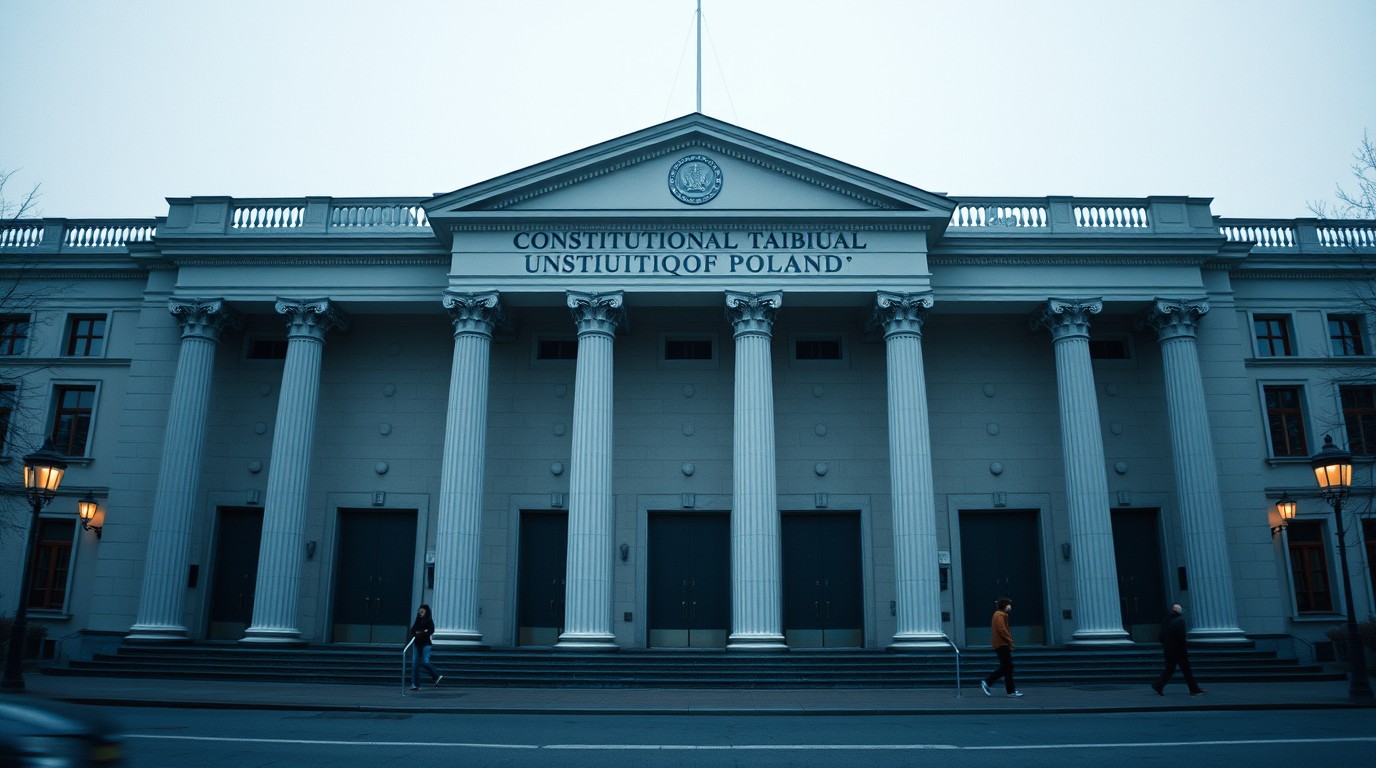
Poland's president, Karol Nawrocki, cut short his flight to Senegal on October 30, 2026 and returned to Warsaw, after the Constitutional Tribunal's most senior judge, Anna Korwin-Piotrowska, suspended the body's president, Bogdan Święczkowski, for one month and took over its leadership.
The suspension rested on Article 130 of the Law on the System of Ordinary Courts, according to El País, which reported that the tribunal's leadership was blocking the General Assembly of judges responsible for approving the budget. The tribunal rejected the measure and maintained that its head remained in office, in a dispute that dates back to 2015 and intensified this year: RTÉ, citing Reuters, reported that Nawrocki refused to swear in three of the six judges proposed by Parliament. The European Court of Human Rights held in 2021 that those appointments violated fundamental rules, according to El País. The episode matters to Mexico and Latin America as a comparative reference on friction between branches of government and rules for judicial appointments, a debate that echoes across several reforms in the region.
After his return, Nawrocki accused the government of Donald Tusk of a forced takeover of a constitutional body, a charge El País attributes to the head of state. The prime minister defended the action: "Restoring the rule of law is our duty," he said, according to the same outlet. Justice Minister Waldemar Zurek called for lifting the immunity of Święczkowski and his deputy, Bartłomiej Sochański. Hundreds of protesters gathered outside the building; police reported three arrests after incidents, and seven judges remained inside the building, according to El País. Slawomir Mentzen, co-leader of Konfederacja, told the newspaper that "this is no longer a constitutional crisis, we are on the brink of a coup d'état."
Judge Korwin-Piotrowska convened the tribunal's General Assembly for November 3, according to El País, and Nawrocki announced urgent consultations with parliamentary leaders. That date will show whether the conflict is channeled through institutional channels or escalates into a new dispute over the legitimacy of the appointments.
This article was written with the assistance of artificial intelligence from verified sources and reviewed by a human editor before publication.