Nearshoring is the relocation of manufacturing to a country neighboring the final market. For companies supplying the United States, Mexico offers tariff-preferential access under the United States-Mexico-Canada Agreement (USMCA), a shared land border, and competitive labor. Querétaro has accumulated nearly $22 billion in foreign direct investment between 1999 and 2024.
What Nearshoring Is and What Is at Stake
The term combines "near" with "shoring," a shorthand for offshoring, which denotes the relocation of productive operations. It differs from classical offshoring, which moves production to distant countries, typically in Asia, to cut labor costs without prioritizing proximity to the customer, and from reshoring, which returns that production to the country of origin. In Mexico's case, the defining advantage is not labor cost alone. It is the combination of geographic proximity, preferential tariff access under a trilateral trade agreement, and the ability to operate in the same time zones as design and engineering teams in the United States.
The Secretaría de Economía (Ministry of Economy) reports that Mexico received $36.872 billion in foreign direct investment (FDI) in 2024. Manufacturing was the leading sector, capturing $18.116 billion, ahead of financial services and mining. That figure positions manufacturing as the central driver of external capital attraction in the Mexican economy.
What is at stake is the country's capacity to capture a lasting share of the global industrial production that companies are shifting out of Asia. The Instituto Mexicano para la Competitividad (IMCO) estimates that FDI in the 57 sectors most closely linked to nearshoring grew at an annual rate of 47 percent during the first nine months of 2023, reaching $15 billion. Over the same period, investment unrelated to this process fell 27 percent.
How We Got Here and How It Works
The phenomenon has two simultaneous triggers. The first is the trade framework. The USMCA, which entered into force on July 1, 2020, replacing the North American Free Trade Agreement (NAFTA), established more demanding rules of origin for key sectors, particularly automotive. Those rules require that a set proportion of the components in a vehicle be manufactured within the North American bloc for the product to qualify for preferential tariffs, reducing the incentive to import parts from Asia for assembly in Mexico. According to the Office of the United States Trade Representative (USTR), total goods and services trade between the United States and its USMCA partners reached $1.8 trillion in 2022, and U.S. FDI in the bloc stood at $569 billion that same year.
The second trigger was the 2020-2021 pandemic. Production disruptions and ocean shipping delays exposed the vulnerability of supply chains stretched across the Pacific. Companies responded with the strategy known as "China+1": maintaining capacity in Asia while adding a second manufacturing base closer to the end consumer. For those supplying the U.S. market, Mexico proved the most viable option in the Americas. The most frequently cited reasons include supply chain delays, rising logistics costs, intellectual property concerns, and the impact of additional tariffs applied to goods of Chinese origin.
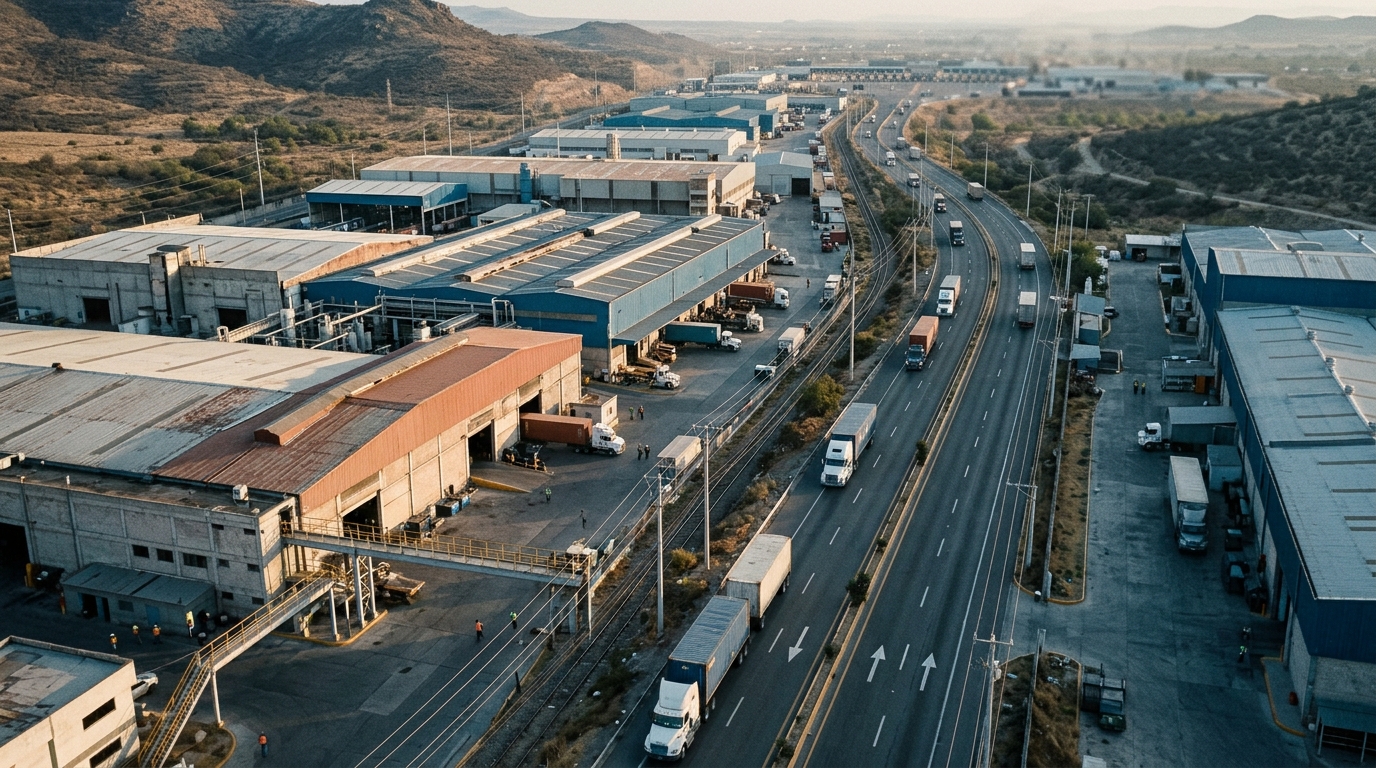
The operational mechanics of nearshoring in Mexico run through industrial parks. A company leases or purchases land within a park, builds its manufacturing facility, and gains access to shared services including electrical substations, water treatment, fiber-optic connectivity, and warehousing logistics. The Asociación Mexicana de Parques Industriales (AMPIP) groups the sector's leading developers. The Bajío states, comprising Guanajuato, Jalisco, Querétaro, and Aguascalientes, concentrate the majority of new industrial space absorption, alongside northern states such as Nuevo León, Chihuahua, and Coahuila.
The most active sectors include automotive and auto-parts manufacturing, medical devices, aerospace, and household appliances. The medical devices sector, valued at more than $16 billion in Mexico in 2022, has concentrated investment in the Bajío for more than a decade, with medical technology and diagnostic equipment manufacturers choosing the region for its availability of skilled technical labor and its proximity to U.S. ports of entry.
Why This Matters for Mexico
The IMCO documents that nearshoring benefits Mexican states very unevenly. In the first nine months of 2023, Aguascalientes recorded 310 percent growth in nearshoring-related FDI; Nuevo León grew 265 percent, and Mexico City 27 percent. Those figures reflect that states with pre-existing industrial infrastructure, mature supply chains, and available technical human capital absorb the majority of new capital.
Querétaro illustrates that dynamic clearly. According to DataMéxico, the state received $1.055 billion in FDI in 2024, with cumulative investment of nearly $22 billion since 1999. The leading source countries for that investment in 2024 were the United States ($495 million), Germany ($246 million), and Canada ($155 million). The state had seven industrial parks registered with AMPIP as of February 2023. Its productive base combines automotive manufacturing with a consolidated aerospace cluster and a network of technical universities that train the technicians and engineers those industries require. The diversification of its investor base, with German and Canadian companies alongside U.S. firms, reduces dependence on a single source market.
At the national scale, the phenomenon involves industrial policy decisions for key institutions. The Secretaría de Economía designs the incentives and agreements that position Mexico against competitors such as Vietnam and Poland in attracting manufacturing investment. The Banco de México (Banxico) monitors the effect of FDI flows on the exchange rate and current account. The Instituto Nacional de Estadística y Geografía (INEGI) produces the statistics that allow for assessing the extent to which manufacturing growth translates into formal employment and regional economic activity.
The IMCO also flags the concentration risk. States with infrastructure deficits or low logistics connectivity, such as Veracruz and Oaxaca, face structural conditions that reduce their competitiveness in attracting nearshoring-cycle investment, which could widen development gaps between states.
What Comes Next
The USMCA review, scheduled for 2026, is the trade policy factor with the greatest near-term bearing on nearshoring. The agreement includes a review clause every six years. Its outcomes will determine whether rules of origin are maintained, tightened, or adjusted, with direct consequences for the supply chains operating under the current framework.
In parallel, the transition toward electric vehicles is generating a new wave of demand for industrial space. The components of that industry, including batteries, electric motors, and energy management systems, have supply chains distinct from those of the internal combustion engine. This opens opportunities for Bajío and northern states, but also demands workforce retraining and new investment in electrical infrastructure.
The IMCO identifies three conditions that will determine how much real benefit Mexico captures in the coming years: investment in energy and water infrastructure in the states with the highest industrial demand; technical training aligned to the fastest-growing sectors; and adequate conditions for long-term investment. Those three variables define the difference between an investment cycle that consolidates in the country and one that migrates toward other destinations.
Frequently Asked Questions
**What distinguishes nearshoring from offshoring?**
Offshoring moves production to distant countries, typically in Asia, to cut labor costs without prioritizing proximity to the customer. Nearshoring brings it to a country close to the final market. For companies selling in the U.S., Mexico offers two-to-three-day truck transit and tariff-free access under the USMCA, in force since July 1, 2020.
**How much investment has nearshoring generated in Mexico?**
FDI in the 57 sectors most closely linked to nearshoring grew 47 percent annually in the first nine months of 2023, reaching $15 billion, according to the IMCO. Mexico's total FDI in 2024 was $36.872 billion; manufacturing captured $18.116 billion, the leading sector, according to DataMéxico.
**Why has Querétaro become an industrial hub?**
Querétaro combines a central location in the Bajío, seven industrial parks registered with AMPIP, automotive and aerospace supply chains with decades of development, and technical universities that train the profiles the industry requires. In 2024 it received $1.055 billion in FDI, primarily from the United States, Germany, and Canada.
**What is the USMCA and what does it have to do with nearshoring?**
The USMCA entered into force on July 1, 2020, and guarantees tariff-free trade between Mexico, the U.S., and Canada. Its regional content rules require that a proportion of key product components, such as automobiles, be manufactured within the North American bloc, incentivizing the installation of productive capacity in Mexico rather than importing parts from Asia.
This article was drafted with artificial intelligence assistance from verified sources and reviewed by a human editor before publication.