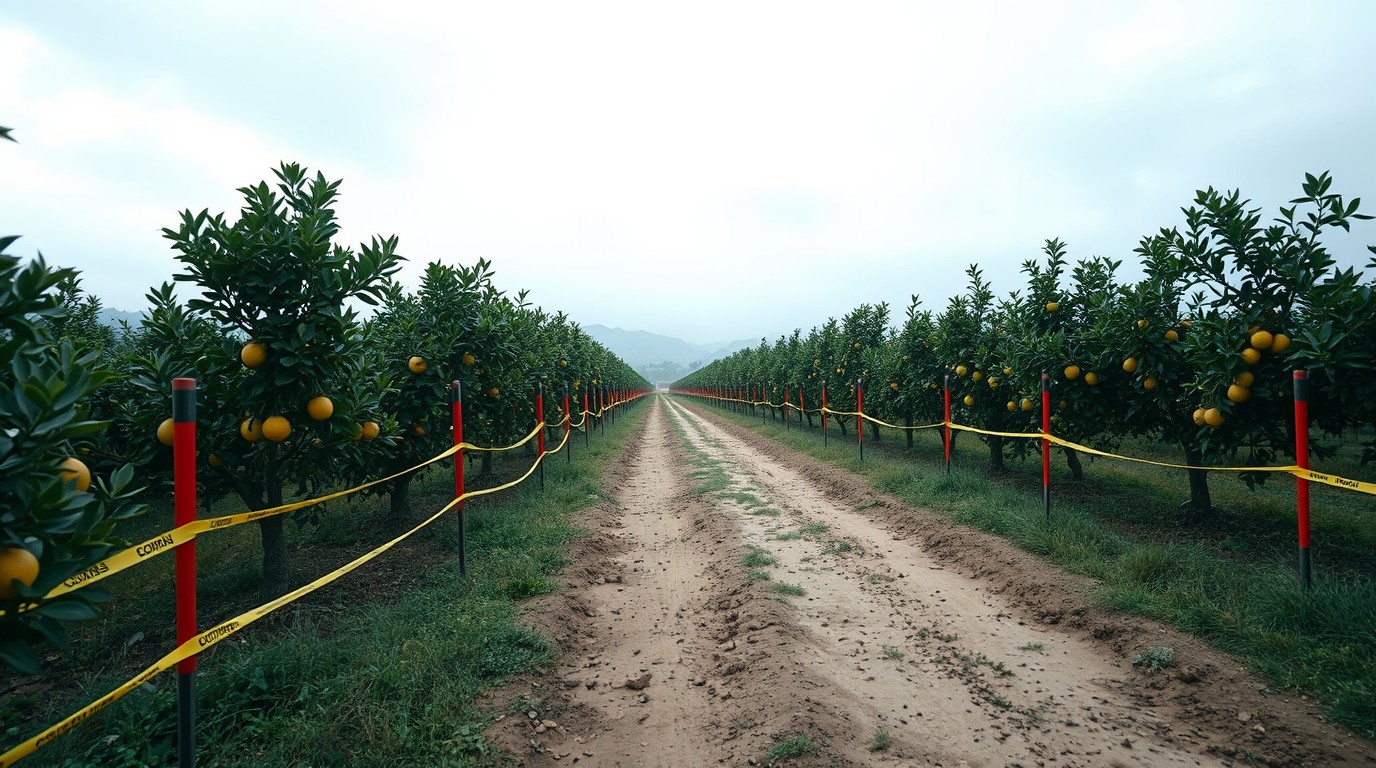
Eight people have died and 16 family members have been recognized as indirect victims of landmine explosions in Apatzingán, Michoacán, over the past twelve months through October 31, 2026, according to files from the State Executive Commission for Victim Assistance (CEEAV) reviewed by Quadratín. Four of those deaths occurred in lemon orchards.
Farmworkers are the most exposed group
The record places agricultural workers as the group most exposed to explosive devices that are no longer confined to roads and dirt tracks. On October 24, during President Claudia Sheinbaum's first visit to Apatzingán, landmine victims handed her documents containing four requests: a security strategy, a return plan for displaced families, comprehensive care and support for the countryside, Proceso reported; the president offered to send an official to address them. Among those who approached her was Leonel González Vargas, a lemon picker who lost a leg in June 2026 when a landmine exploded as he was transporting a crew in El Guayabo. For Mexico the data has a productive dimension: Apatzingán is part of one of the most important lemon-growing areas in Michoacán, with farmworkers laboring on plots where explosives have been found.
Four farmworkers killed in 2025
The CEEAV documents four cases of farmworkers in 2025. On February 8, Pablo Ríos Buenrostro, 15, died when he set off a landmine with a hoe in an orchard in Santa Ana Amatlán; the following day José Luis Ramírez López, 42, died from another device in an orchard in the municipality. On April 2, Fredis Carranza Morales, 62, lost his life on a road at the La Joya property in Puerta de Alambre, and on May 20 José Armando Estrada Zamora, 27, died in La Magueyera, El Alcalde, while checking irrigation hoses with his father. The commission recognized 16 family members as indirect victims, with needs for food, education, transportation, psychological care and housing; Pablo's 28-year-old mother and his 11- and 9-year-old siblings were displaced after the teenager's death.
Displacement by stealth
The pattern is displacement by stealth: families leave their homes and return by day to check on properties and livestock; some send animals ahead to detect hidden charges, explained Julio Franco of the Apatzingán Observatory for Human Security. The CEEAV establishes a baseline of identified needs; the safe return plan is the next checkpoint.
This article was written with the assistance of artificial intelligence from verified sources and reviewed by a human editor before publication.