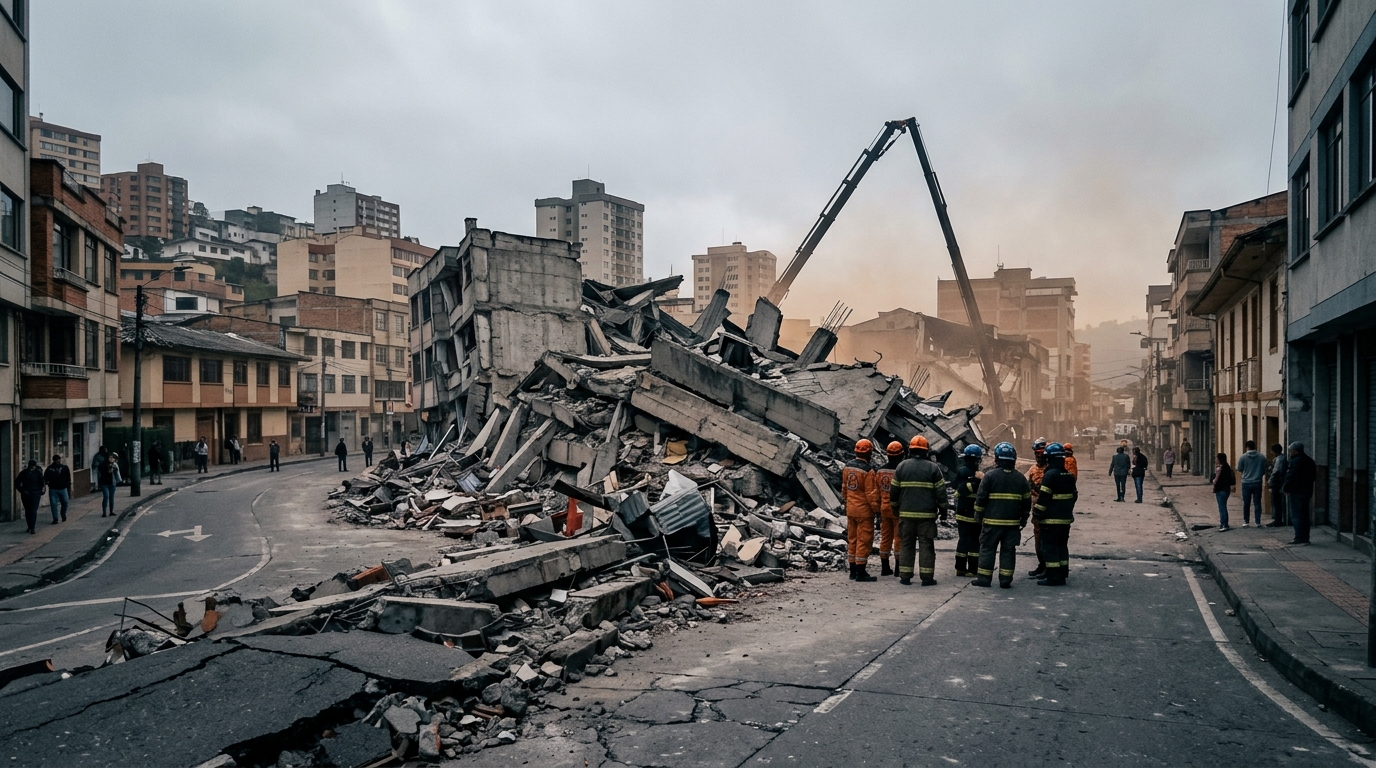
The magnitude 7.4 earthquake that struck western Colombia on Monday, August 10, left more than 130 dead and prompted the government to declare a national state of emergency, with more than 2,700 people reported missing, according to El País and AP.
The epicenter was located in San José del Palmar, in the department of Chocó, one of the most isolated regions in the country, where parts of the territory are accessible only by boat, jungle trail, or small aircraft, according to AP. President Abelardo de la Espriella, who took office on Friday, August 7, set up unified command posts in Bogotá, Quibdó, Cali, and Armenia, and traveled to the disaster zone. International aid was mobilized within hours: the United States announced $15.5 million and the CAF a donation of $500,000, according to El País. Mexico, which operates the seismic alert system and maintains reconstruction funds for disasters, can use the speed of that activation as a benchmark for measuring the readiness of its own mechanisms in the event of an earthquake of comparable magnitude.
The earthquake, the strongest in Colombia since 1979, was also felt in Ecuador, Panama, and Venezuela. By Monday night, the Colombian Association of Capital Cities (Asocapitales) had recorded 132 deaths and more than 500 injuries, while AP reported approximately 1,600 buildings damaged or collapsed. In Cali, where a curfew was imposed, the number of missing reached 188 and more than 5,000 homes were reported affected; Pereira, Quibdó, and Manizales sustained the most severe damage, with hospitals evacuated. AP describes the earthquake as the first major test for the administration that took office on Friday. The death toll continues to rise as rescue teams work through the rubble and families post information about the missing on citizen-run websites.
The reconstruction phase will test the financing mechanisms already set in motion, while the government is set to name the new head of the National Disaster Risk Management Unit on Tuesday. For Mexico, the signal to watch is how quickly that financing becomes operational when a disaster strikes.
This article was written with the assistance of artificial intelligence based on verified sources and reviewed by a human editor before publication.