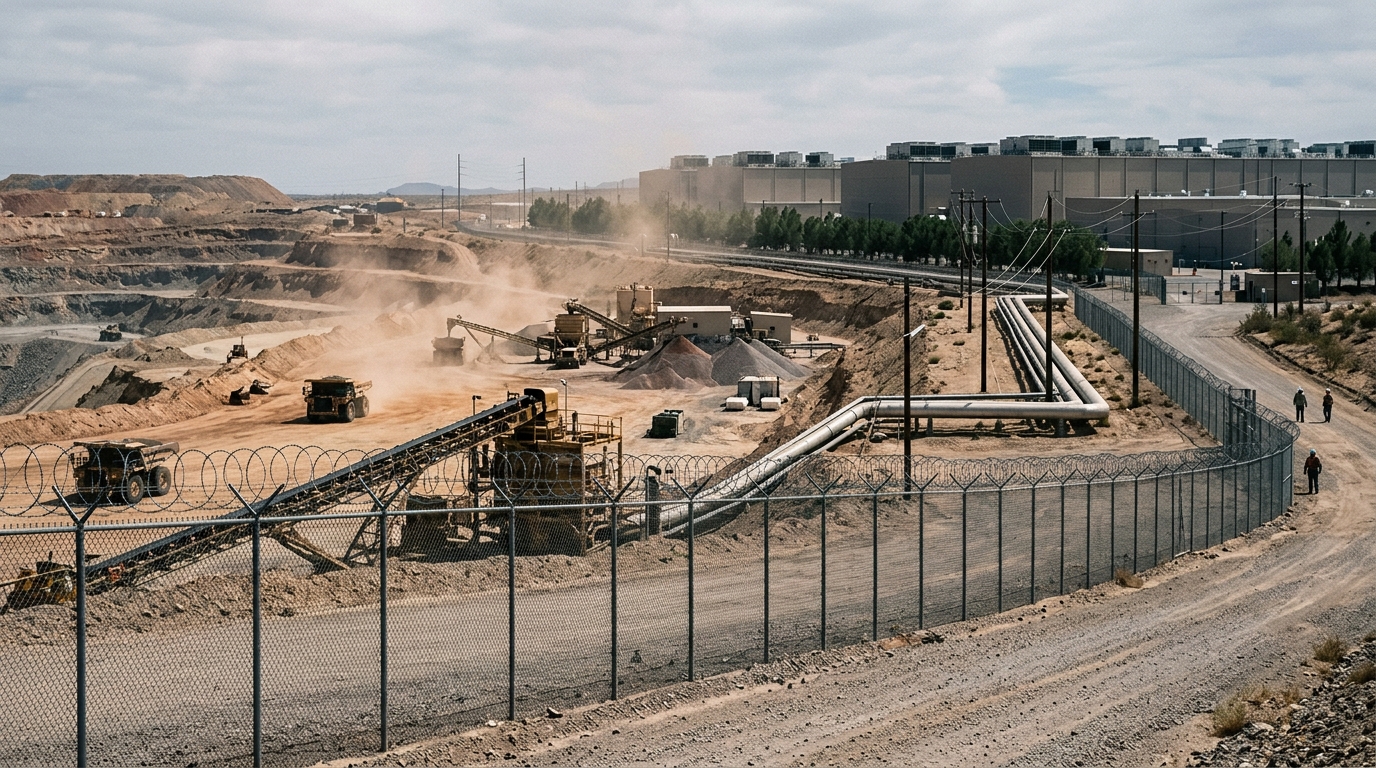
Artificial intelligence does not run on code. It runs on copper, graphite, and rare earths. The global expansion of data centers has turned these inputs into the most contested resource of the century, and Mexico, with strategic reserves in Sonora and Coahuila, holds a defined place in the realignment already underway.
What It Is and What Is at Stake
Critical minerals are materials whose supply faces geopolitical concentration risks and whose absence stalls industries of strategic importance: clean energy, defense, advanced manufacturing, and, increasingly, artificial intelligence infrastructure. The list varies by country, but converges on approximately thirty materials. The most relevant for today's technology supply chain include copper, lithium, cobalt, graphite, gallium, germanium, heavy rare earths, tungsten, and niobium.
The connection to artificial intelligence is not metaphorical. Servers running large language models demand copper in their electrical and cooling systems. High-performance chips, such as those used in generative AI applications, require gallium and germanium for compound semiconductors. Data center backup batteries consume lithium and cobalt. The International Energy Agency (IEA) documented in its Critical Minerals Global Outlook 2026, published in July 2026, that the leading refining country concentrates 72% of global refining capacity, up from 70% recorded in 2023. Concentration continues to deepen.
What is at stake is who controls the physical bottleneck of the digital economy. A language model can be trained on any cloud, but that cloud requires hardware built from minerals sourced from a small number of countries. The AI race has, beneath its software layers, a geological dimension that markets are only beginning to absorb.
How We Got Here and How It Works
Demand for critical minerals is not new, but its profile shifted over the past three years. For two decades, the primary driver was the energy transition: wind turbines, solar panels, and electric vehicles absorbed lithium, cobalt, and copper at historically unprecedented rates. What accelerated the most recent cycle was the expansion of artificial intelligence infrastructure between 2023 and 2025, which added a parallel demand stream with its own dynamics: concentrated in few countries, urgent, and with shorter procurement cycles.
China built its position over decades. According to the IEA, the country controls approximately 50% of global copper smelting capacity, a share that stood at just 15% in 2005. In the refining of most strategic minerals, concentration is even greater: the leading refiner holds 72% of global capacity. When Beijing expanded its export controls to seven heavy rare earth elements in April 2025, prices of those materials in Europe climbed to approximately five times Chinese domestic prices. Tungsten increased sixfold and cobalt recorded a rise of approximately 130%, driven in part also by export restrictions from the Democratic Republic of the Congo.
The response from advanced economies was reactive but substantial in scale. Public financing commitments in developed countries reached approximately 65 billion dollars in 2025, four times the figure recorded in 2023, according to the IEA. Mergers and acquisitions in the sector rebounded that year, with copper assets leading a 20% increase in total deal value compared to 2024. Even so, total investment in critical minerals fell 9% in 2025, and lithium recorded a 40% reduction as prices declined.
Latin America is emerging as the geological counterpart to Asia in this realignment. The region produces between 40 and 46% of global copper. Chile, the largest individual producer, generated 5.3 million tonnes in 2024, close to one quarter of global production, according to J.P. Morgan Private Bank analysis. The region holds 38% of known copper reserves and more than 20% of nickel reserves. Nevertheless, approximately 70% of global battery materials processing capacity remains in China, creating a structural gap: Latin America extracts, China processes, and developed countries consume.
Why This Matters for Mexico
Mexico is not the largest actor in the region, but it is among the most strategically positioned, both for its reserves and for its proximity to the United States. National mining output reached 317,460 million pesos in 2024, an increase of 19.6% over the prior year, according to data from Expansión Política. The country produces copper, graphite, fluorite, cobalt, aluminum, magnesium, and rare earth elements, several of which appear on the official U.S. critical minerals list.
The productive geography is specific. Sonora accounts for 70% of national copper output, the mineral with the highest projected demand within the AI supply chain. Coahuila holds deposits of cerium, lanthanum, neodymium, and praseodymium, rare earths used in permanent magnets, electric motors, and precision optical components. Baja California Sur and Sonora hold cobalt deposits. Fluorite, an input in semiconductor and optical glass manufacturing, is concentrated in San Luis Potosí. Graphite, a material used in battery anodes, is produced in Sonora.
On February 5, 2026, Secretary of Economy Marcelo Ebrard and U.S. Trade Representative Jamieson Greer formalized a bilateral Action Plan on critical minerals, as reported by Milenio. The agreement covers 20 materials, including lithium, copper, graphite, cobalt, rare earths, antimony, titanium, vanadium, and uranium. It establishes coordination on trade policies, geological data sharing with the U.S. Geological Survey (USGS), and the development of joint projects spanning exploration through integrated manufacturing. On the financing side, U.S. legislators introduced proposals to raise the lending capacity of the Export-Import Bank of the United States (EXIM) by 70 billion dollars, partly directed at projects in North America.
What Comes Next
International Energy Agency projections place the potential copper deficit between 20 and 40% by 2035, and the lithium deficit between 30 and 60% over the same horizon. Lithium demand is projected to be five times greater by 2040, and nickel demand nearly double by that date, according to J.P. Morgan Private Bank estimates.
Three variables concentrate the attention of those analyzing the supply chain. The first is the trajectory of Chinese export controls: any expansion of restrictions on materials such as refined copper or artificial graphite directly pressures chip production costs worldwide. The second is the pace at which processing capacity is built outside China. The 2025 financing commitments are partly directed at refining plants in North America and Europe, and their effectiveness will become apparent in the second half of the decade. The third is the implementation of the Mexico-United States Action Plan, which during 2026 moves from a formal declaration to concrete joint exploration and development projects.
For sectors with a mandate over mining and energy in Mexico, the demand horizon is clear. The open variable is how quickly the processing infrastructure is built that transforms geological wealth into an industrial position within the global AI supply chain.
Frequently Asked Questions
**What are critical minerals and how do they differ from other natural resources?** They are materials whose supply faces geopolitical concentration risks and whose absence paralyzes strategic industries. Unlike oil, which has many producers, the refining of these minerals depends on a small number of countries. According to the IEA, the leading refiner holds 72% of global capacity in 2025.
**Why does artificial intelligence need critical minerals?** Data centers require copper in their electrical and cooling infrastructure. High-performance chips use gallium and germanium for compound semiconductors. Backup batteries consume lithium and cobalt. Without these materials, the physical infrastructure that makes industrial-scale AI possible does not exist.
**What are the main critical minerals produced by Mexico?** Mexico produces copper (Sonora accounts for 70% of national output), graphite (Sonora), fluorite (San Luis Potosí), cobalt (Sonora and Baja California Sur), and rare earths such as cerium, lanthanum, neodymium, and praseodymium in Coahuila. Total mining output reached 317,460 million pesos in 2024, a 19.6% increase over 2023.
**What does the bilateral Mexico-United States agreement signed in 2026 cover?** The bilateral Action Plan, signed on February 5, 2026 by Secretary Ebrard and Representative Greer, covers 20 minerals. It establishes regulatory coordination, geological data sharing with the USGS, and joint projects spanning exploration through manufacturing. It includes legislative proposals to expand the EXIM lending limit by 70 billion dollars.
This article was produced with artificial intelligence assistance from verified sources and reviewed by a human editor before publication.