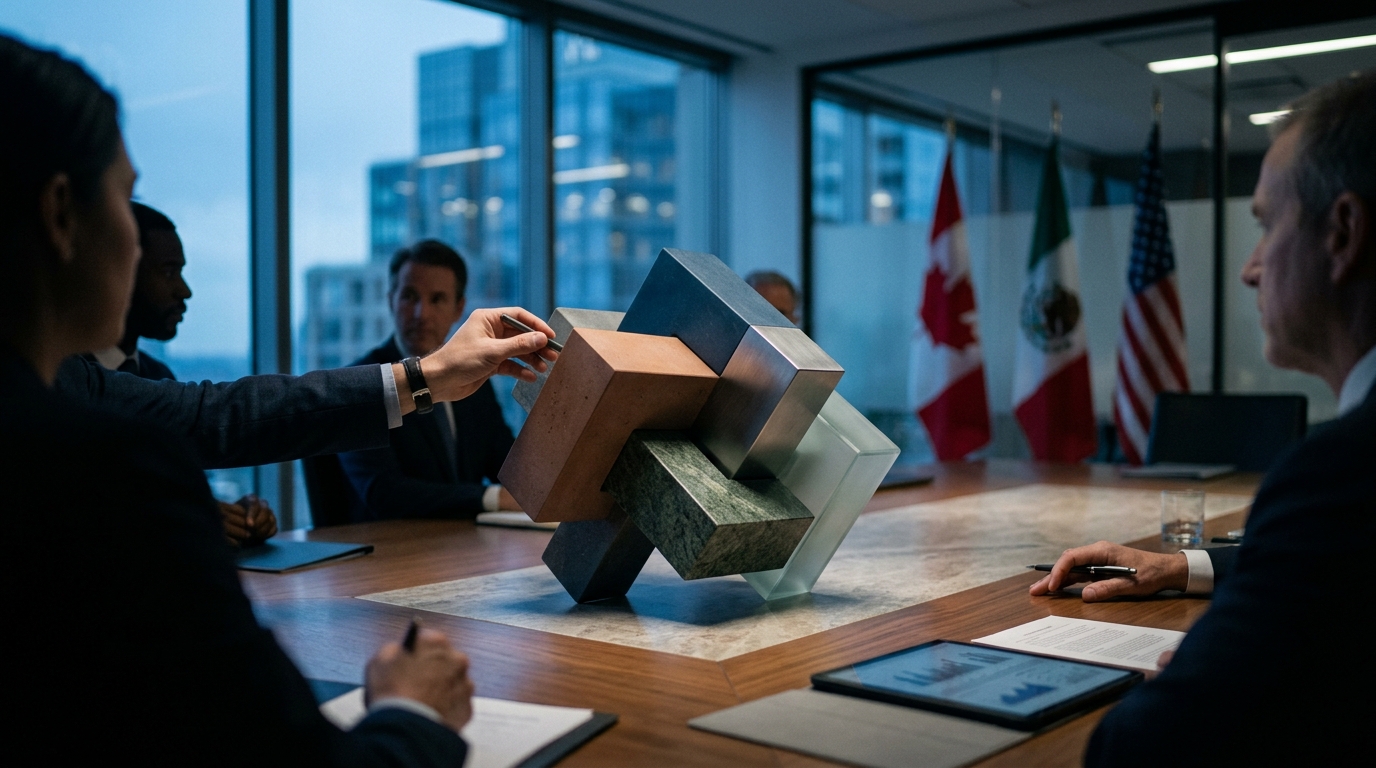
The United States-Mexico-Canada Agreement (USMCA) began its first mandatory joint review on July 1, 2026, a step envisioned since its signing to decide whether the agreement extends for another 16 years. The United States did not confirm the extension; Mexico and Canada did, which opened a cycle of annual reviews with direct consequences for the Mexican economy.
What it is / what is at stake
The USMCA includes a sunset clause, the first of its kind in a United States trade agreement, as documented by the Congressional Research Service. Article 34.7 of the treaty establishes that, six years after its entry into force on July 1, 2020, the three parties must confirm in writing whether they wish to extend the agreement for another 16 years. If all three confirm, the term renews automatically. If a single party does not, the treaty does not expire: it remains in force until the end of its original term, July 1, 2036, but enters a regime of annual reviews until there is an agreement or the term runs out.
That is exactly what happened. The USMCA Free Trade Commission, made up of representatives of the three governments, met virtually on July 1, 2026 for the six-year review. The United States did not agree to renew the agreement in its current form, according to the analysis by EIG Law, while Mexico and Canada did back a 16-year extension.
What is at stake is not the immediate validity of the treaty, which none of the parties questions, but the terms under which North American trade will operate over the next decade. For Mexico, where more than 80% of exports go to the United States, according to Expansión, the outcome of this review shapes investment certainty and the design of regional supply chains.
How we got here / how it works
The mechanism was not improvised. When the USMCA replaced the North American Free Trade Agreement and entered into force on July 1, 2020, it incorporated a compliance calendar that requires the United States to give public notice well in advance. According to the Congressional Research Service report, the Office of the United States Trade Representative (USTR) had to publish a notice in the Federal Register at least 270 days before the review (it did so on September 17, 2025) and hold public hearings, which took place from December 3 to 5, 2025. The same report documents that the USTR must also deliver to Congress, at least 180 days before the review, a report on the operation of the agreement and the actions it proposes, and that the House Ways and Means Committee and the Senate Finance Committee receive briefings before and after each review.
With that scaffolding in place, the USMCA Free Trade Commission met virtually on July 1, 2026. The result, documented by EIG Law, was that the United States sought to address what it described as shortcomings of the agreement and trade deficits with Mexico and Canada, and did not agree to renew it in its current form. Faced with that scenario, Washington chose to negotiate bilaterally with each partner instead of resolving the trilateral extension in one go.
With Mexico, that bilateral track has already gone through several rounds. According to statements by Economy Secretary Marcelo Ebrard Casaubon, reported by Expansión, the second round concluded on June 18, 2026 in Washington with progress on rules of origin, economic security, agriculture and the automotive industry. Ebrard announced a virtual meeting on July 1 and an in-person round in Mexico City on July 20 to continue negotiating. Among the topics on the table are also steel, aluminum and their derivatives, electronic payment services and regulatory compatibility, which is discussed in a committee created under chapter 12 of the treaty.
Why it matters for Mexico
For Mexico, the outcome of this review is not a diplomatic technicality. More than 80% of Mexican exports go to the United States, according to Expansión, which concentrates a large part of the country's economic growth in a single trade relationship. The same report notes that Mexico faces, for the first time in three decades, a decline in its agricultural exports to the United States, a data point that illustrates how much tariff certainty weighs on sectors that previously were not among the most sensitive to the bilateral relationship.
The uncertainty tied to the review is already reflected in macroeconomic projections. Banco de México cut its 2026 growth estimate from 1.6% to 1.1%, according to El Financiero, after a 0.6% contraction in the first quarter of the year. The central bank attributed the adjustment to weaker economic activity and to trade uncertainty with the United States, and noted that the USMCA review can work in both directions: as a downside risk if it drags on unresolved, or as a factor that drives an investment recovery if it concludes with clear conditions for the coming years.
The Economy Secretariat, led by Marcelo Ebrard, is conducting the bilateral negotiation with the United States and has put on the table the sectors that generate the most employment and investment in the country: automotive, steel, aluminum, medical devices and the supply chains that depend on the treaty's rules of origin. None of those sectors can plan long-term investments without knowing what tariffs and what rules will govern after 2026, which explains why the review is being followed closely well beyond diplomatic circles.
What comes next
As long as there is no trilateral agreement, the USMCA enters a cycle of annual reviews that will repeat every year until 2036, as established by Article 34.7.4 cited by the Congressional Research Service. That does not mean the treaty is at risk of disappearing: it remains fully in force and its 16-year extension can be confirmed at any time if the three parties agree.
In the short term, the relevant calendar is that of the bilateral rounds between Mexico and the United States. After the virtual meeting on July 1 and the round in Mexico City on July 20, 2026, the technical tables on automotive rules of origin, steel and aluminum, agriculture and regulatory compatibility continue, according to what Ebrard reported to Expansión. There is no legal deadline to close these conversations: the annual review mechanism itself leaves room to keep negotiating without the agreement losing force.
The points to watch in the coming months are whether the United States offers a more defined position on the 16-year extension, whether the sectoral tables produce concrete changes in rules of origin or tariffs, and whether the chapter 12 committee advances on regulatory compatibility, a less visible terrain than automotive but with direct effects on investment.
Frequently asked questions
**What is the 2026 USMCA joint review?** It is the mechanism under Article 34.7 of the treaty for Mexico, the United States and Canada to confirm whether they extend it for another 16 years. It took place on July 1, 2026 and the United States did not confirm the extension at that session.
**Did the USMCA stop being in force?** No. The treaty remains in force until July 1, 2036 and the extension can be confirmed at any time. What changes is that there are now annual reviews until the three parties reach an agreement.
**Which Mexican sectors are at the negotiating table?** Automotive, steel, aluminum, agriculture, rules of origin, economic security and regulatory compatibility, according to what Economy Secretary Marcelo Ebrard reported after the bilateral round on June 18, 2026 in Washington.
**How does this affect the Mexican economy?** Banxico cut its growth forecast for 2026 from 1.6% to 1.1% and pointed to trade uncertainty with the United States as one of the factors behind the adjustment, along with weaker economic activity.
This article was written with the assistance of artificial intelligence based on verified sources and reviewed by a human editor before publication.