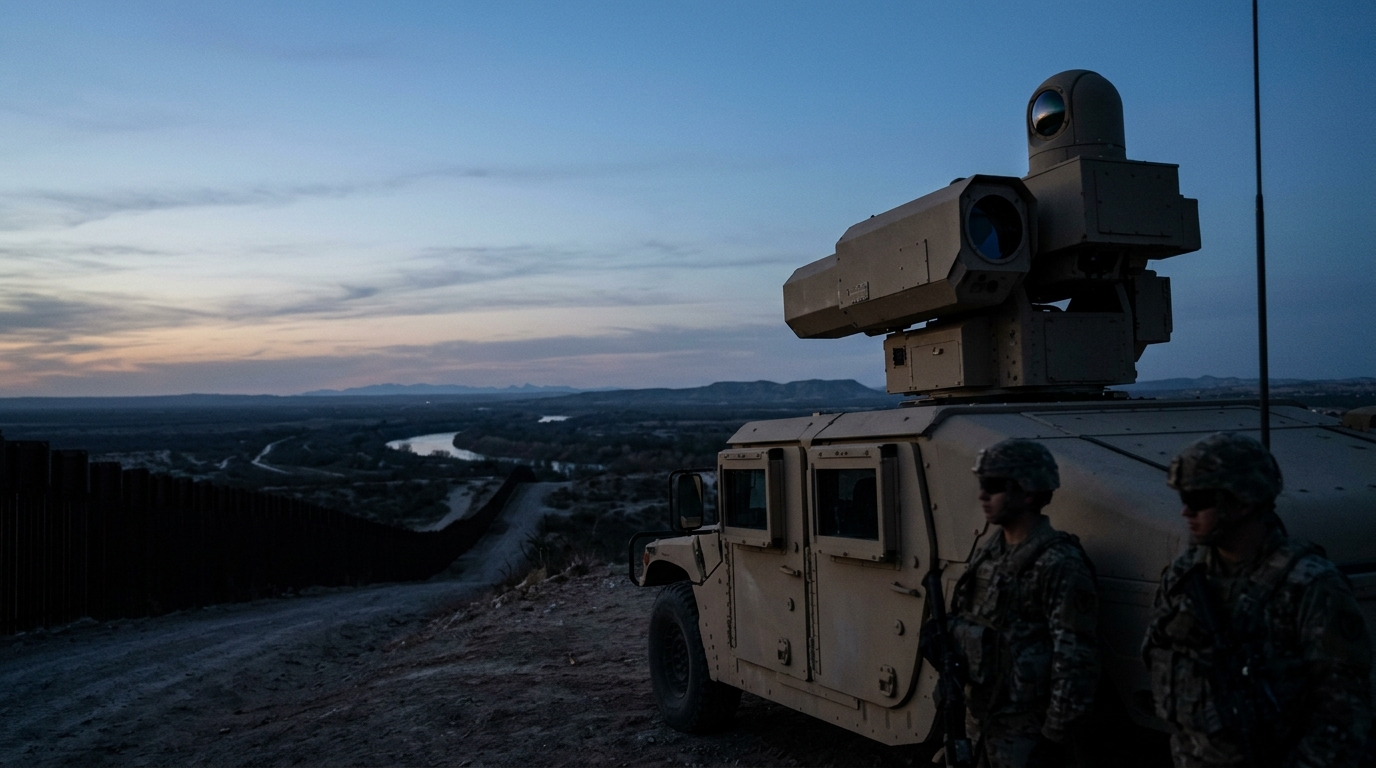
The U.S. Army shot down three drones using a high-energy laser near the border with Mexico, between the night of August 25 and the early hours of August 26, in the Rio Grande Valley, Texas. It was the first reported use of the AMP-HEL system against unmanned aircraft in the border sector.
The operation was carried out by Joint Task Force Southern Border (JTF-SB), operating under U.S. Northern Command. Since its establishment in 2025, the force has logged tens of thousands of detection patrols and thousands of observation flights, according to the task force's statement, which noted that the drones posed a physical threat to its personnel and that of Customs and Border Protection. The command did not specify whether the shootdowns occurred on U.S. or Mexican territory, and President Claudia Sheinbaum has said she considers any unilateral U.S. action on Mexican soil a serious violation of national sovereignty. In the region, authorities from both countries are working jointly against the rising use of drones, which criminal organizations use to surveil trafficking routes and, in other parts of Mexico, to deploy explosives.
The system used derives from the Army's AMP-HEL program, whose first prototypes were delivered by AeroVironment in September 2025 and two additional units in December of that year, according to Wired. The Locust platform, rated at 20 kilowatts, mounts on military vehicles and uses sensors, cameras, and radars to detect, track, illuminate, and damage targets at a distance; the most recent versions integrate radar and command-and-control systems. Commander Curtis Taylor said that criminal networks are increasingly using unmanned aircraft to facilitate the illicit trafficking of people and to surveil military and Customs and Border Protection personnel, and he expressed appreciation for the support of their Mexican Army counterparts.
The shootdown adds the first operational record of directed-energy weapons in border defense, which the force integrates with layered countermeasures. Authorities from both countries maintain cooperation against drones in the region, and the program expanded to four units delivered in 2025, with integrated radar and command and control.
This article was written with the assistance of artificial intelligence based on verified sources and reviewed by a human editor before publication.