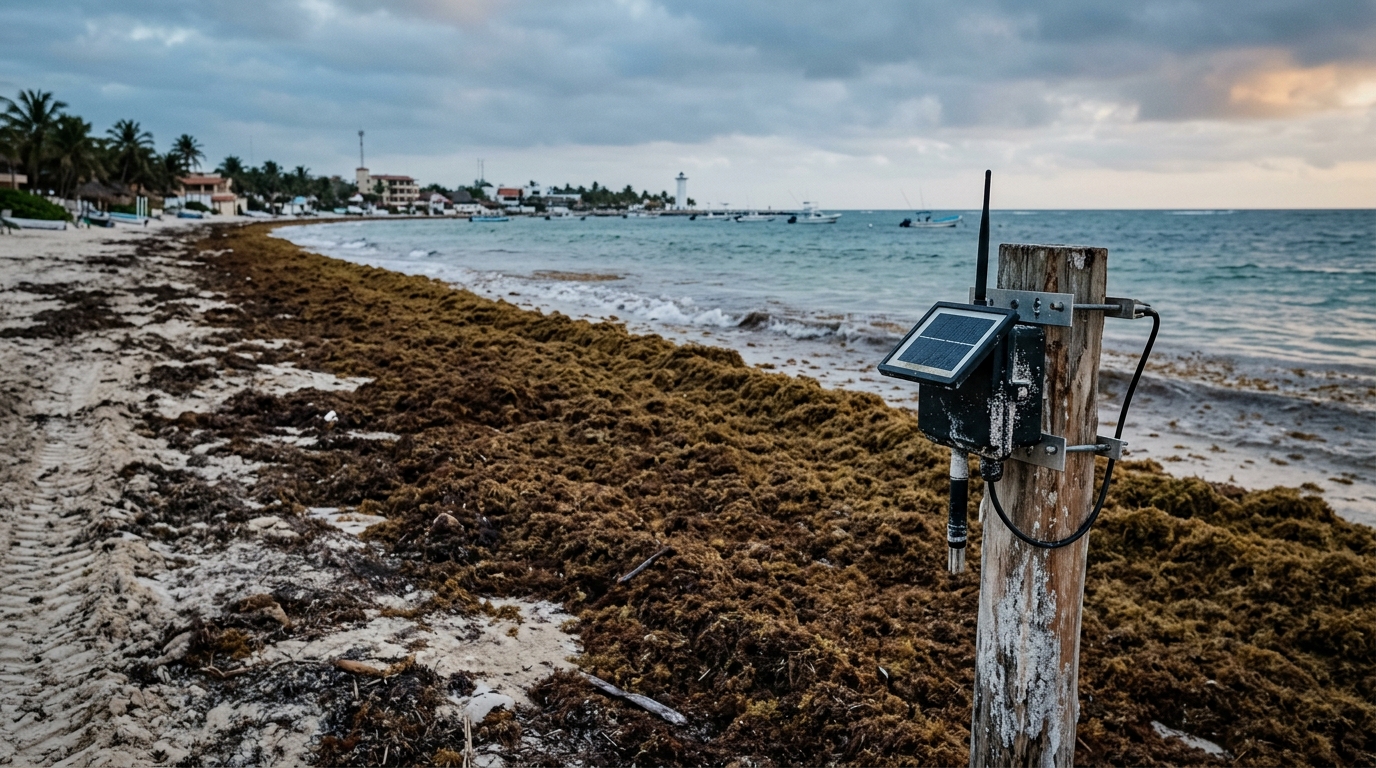
UNAM's Institute of Marine Sciences and Limnology announced on August 17, 2026, the expansion of its hydrogen sulfide monitoring program on Puerto Morelos beaches, following readings of up to 50 parts per million among sargassum collectors, 50 times the occupational limit for eight-hour shifts.
Hydrogen sulfide is released as sargassum decomposes on the sand, and its odor is detectable at 0.7 parts per million, although the olfactory system adapts and ceases to be a reliable indicator. Mexico's Official Standard NOM-010-STPS-2014 sets the maximum concentration at one part per million for eight-hour shifts and limits exposure above five parts per million to 15 minutes, according to Excélsior. The issue is of particular concern to Mexico because Quintana Roo is recording historically high accumulations this year, from Mahahual to Isla Mujeres, and exposure affects residents and tourists alike: studies in Martinique found that the gas can spread up to two kilometers from the shoreline and was associated with respiratory, neurological, and gastrointestinal symptoms in exposed populations, according to El Universal.
In the first phase, 35 sargassum collectors from Puerto Morelos, Playa del Carmen, and Mahahual wore chest-mounted sensors that recorded an average concentration of 1.8 parts per million and peaks of up to 50. Among the group evaluated, 46.9% reported skin itching and burning; 43.8% reported headaches; and 37.5% reported dermatitis and chronic fatigue, according to Excélsior. The new phase deployed nine fixed sensors in homes and beach locations in Puerto Morelos, with detection capability down to 0.001 parts per million, measurements every 30 minutes, and real-time transmission, to measure how gas concentration diminishes with distance, according to El Universal.
The new phase aims to determine how concentration and exposure time interact for residents and tourists on the front line of the coast, given what researcher Rosa Rodríguez described as chronic exposure. With measurements taken every 30 minutes, the upcoming data will reveal how gas levels vary as the season progresses.
This report was written with artificial intelligence assistance based on verified sources and reviewed by a human editor before publication.