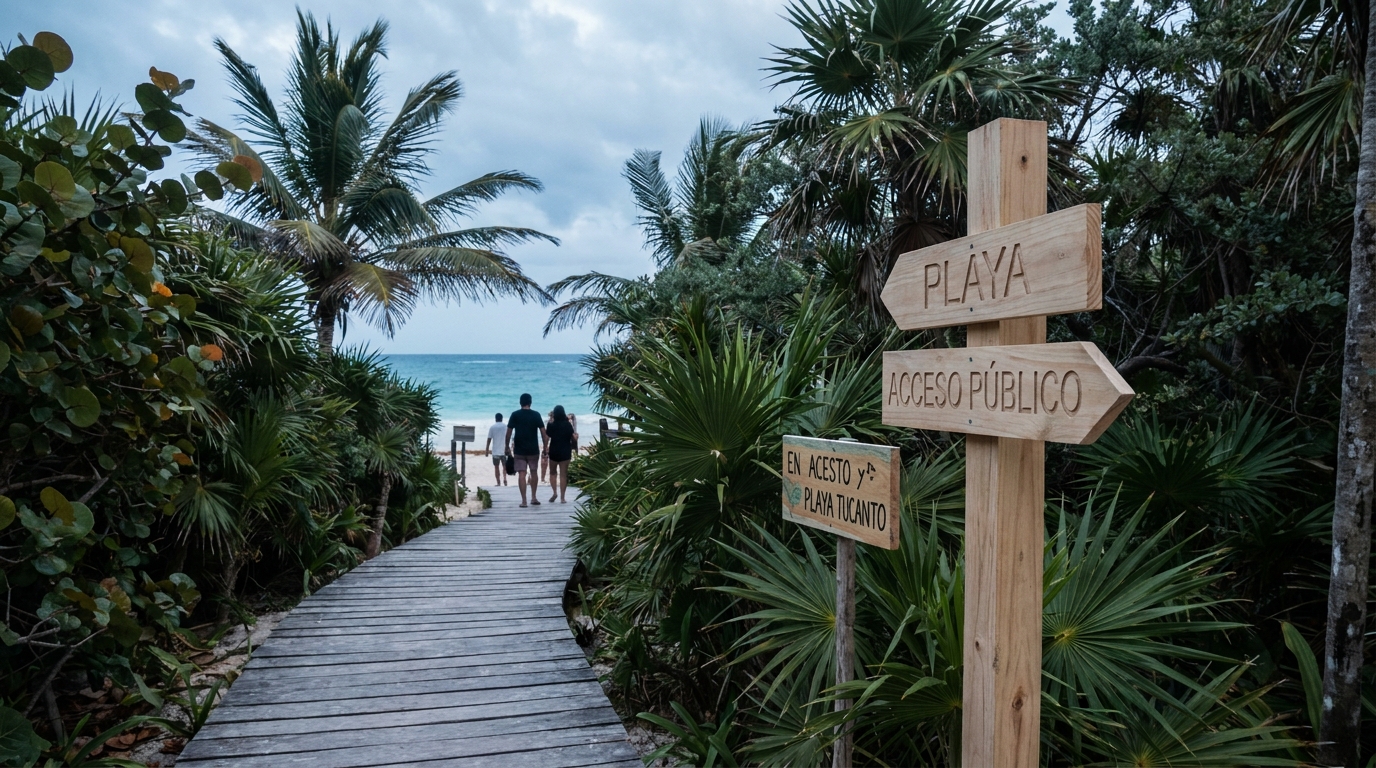
On July 17, 2026, the federal government unveiled Plan Tulum Renace, a 10-action strategy that cuts fees, guarantees free beach access, and rolls out transport and land-use infrastructure at one of the most visited destinations in the Mexican Caribbean. The announcement came during the morning press conference led by President Claudia Sheinbaum from Tulum, Quintana Roo.
Tourism Secretary Josefina Rodríguez Zamora framed the plan as a coordinated effort across all three levels of government and the hotel sector. Sheinbaum met with 30 hotel owners and community representatives ahead of the announcement, according to Quadratín. The strategy extends a sequence of public investment in the area: the Tulum International Airport, the Mayan Train, and Parque del Jaguar, which opened in 2024. For other Mexican coastal destinations navigating the tension between mass tourism and public access, the Tulum model offers a governance template in which beaches are a guaranteed public good, not a hotel privilege.
The plan, as detailed by La Jornada, includes the following measures:
- Free admission to Parque del Jaguar for all domestic visitors.
- Reduced fees at the archaeological zone and the Protected Natural Area: 80 pesos for Mexicans and 265 for foreigners, with free entry on Sundays for nationals. The new rates were published on July 17 in the Diario Oficial de la Federación.
- An electric mobility system within the park, operated by Grupo Mundo Maya, at a cost of 20 pesos.
- A tourist-services model coordinated with the National Guard.
- Professionalization and certification of tourism service providers.
- Construction of a parking facility at the park's southern entrance.
- A land-use and public-services improvement program for the municipality of Tulum.
- A new local public transit system.
- A permanent national and international tourism promotion campaign.
- Attraction of new air routes and strengthened connectivity with the Tulum International Airport.
Rodríguez Zamora also confirmed 10 free public access points to the beaches (Santa Fe, traditional, and southern) and the removal of the wall at the main entrance, which will be replaced by a Mayan-architecture design.
The plan sets a next phase for November 2026: the inauguration of nighttime lighting at the Tulum archaeological zone, which will open an adjacent artisan and cultural corridor. The combination of guaranteed access, tiered pricing, and a nighttime cultural offer sketches a management model that other coastal municipalities will watch closely.
This article was drafted with artificial intelligence assistance from verified sources and reviewed by a human editor before publication.