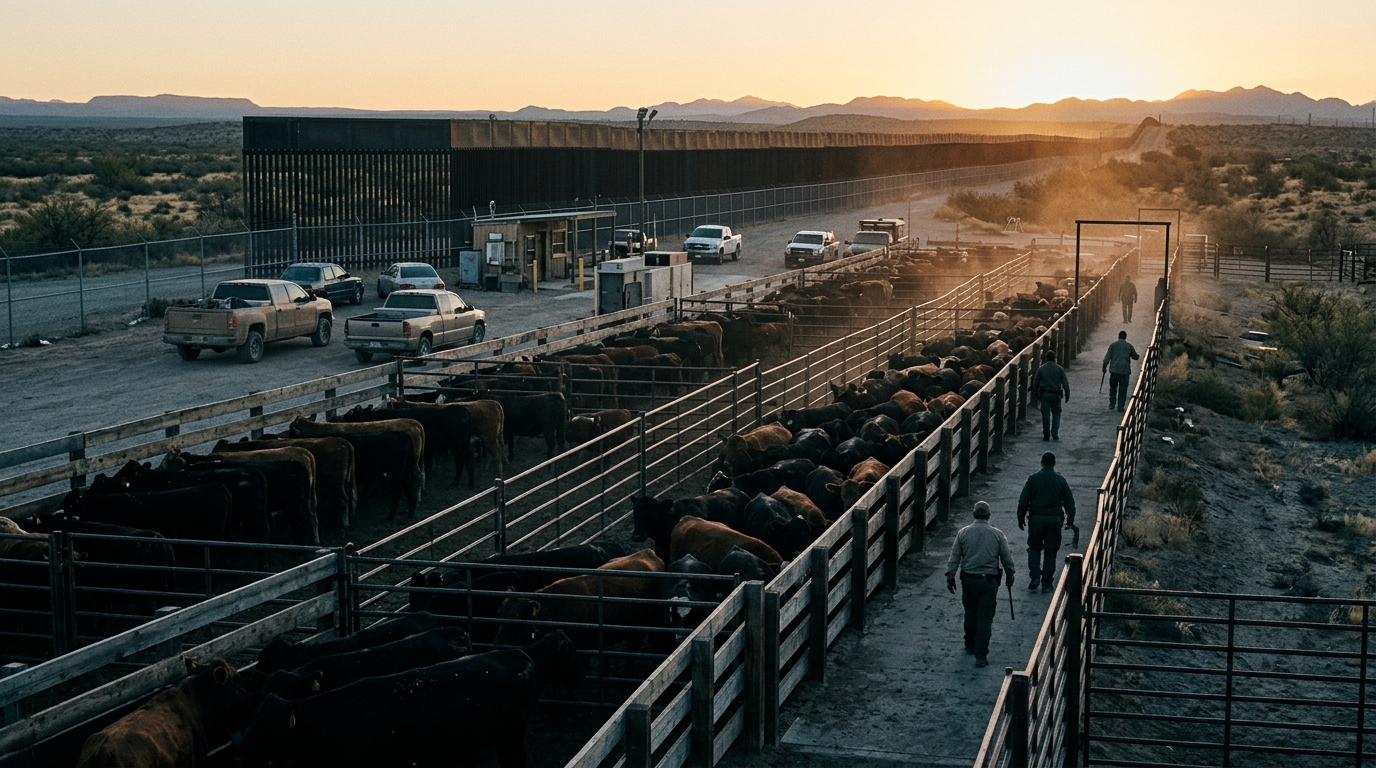
Sonora will resume live cattle exports to the United States through the Agua Prieta crossing at the Arizona border on Monday, August 24, after nearly two years of suspension due to the screwworm. The reopening proceeds despite the state confirming its first case of the infestation this week.
The screwworm is the larva of the fly Cochliomyia hominivorax, which invades open wounds of warm-blooded animals and destroys tissue. The infestation entered Mexico in November 2024 and is present in 30 of the 32 states. The United States banned purchases to protect its herd, though it has been reporting cases in Texas and New Mexico for the past two months, according to AP. Sonora's Secretary of Agriculture and Livestock, Juan González Alvarado, told El Heraldo de México that the agreed date holds despite the case detected in Álamos, and that the protocol is led by Senasica, the Ministry of Agriculture and Rural Development, and the United States Department of Agriculture (USDA).
The crossing will operate under a joint inspection protocol at the Agua Prieta quarantine station. According to Arturo Ruiz, head of animal health for Sonora, cited by AP, the flow will begin at 700 head per day in the first week, rise to 900 in the second, and grow in stages to 1,300. Incoming cattle will face new controls:
- Detection arches for radio-frequency identifiers placed in the ears of cattle.
- Trained dogs to assist USDA officials in inspection before authorizing passage.
- A shipment of more than two thousand sterile flies to be released in Sonora, with Senasica brigades operating within a 20-kilometer radius, according to the Sagarhpa secretary.
Before the suspension, Mexico sent approximately 1.2 million head to the United States per year, primarily from Chihuahua, Sonora, and Tamaulipas. The U.S. herd stands at around 86 million head, the lowest level in 75 years.
Agua Prieta is the first segment of a phased reopening: the daily quota will grow from 700 to 1,300 head, and Sonora producers expect to close their first sales by October. The performance of that flow will indicate how quickly northern Mexico recovers a market of approximately 1.2 million head per year.
This article was written with artificial intelligence assistance based on verified sources and reviewed by a human editor before publication.