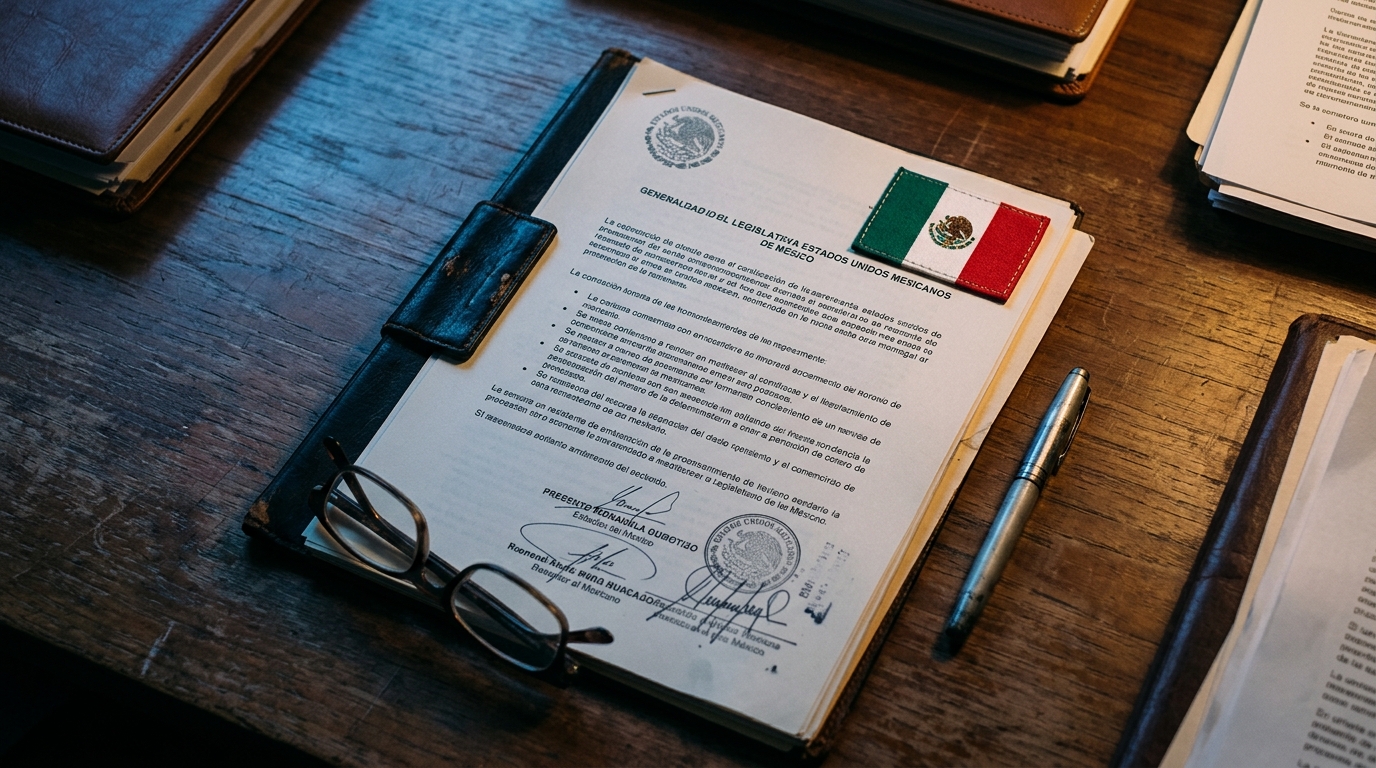
President Claudia Sheinbaum sent to the Senate on August 30 a reform to the Foreign Investment Law that establishes a national security review mechanism for foreign acquisitions. The initiative includes fines of up to 23.5 million pesos for those who defy its rulings.
The reform strengthens the National Foreign Investment Commission (CNIE), which now includes the Ministries of National Defense, the Navy, and Public Security and Citizen Protection with full voting rights, along with the Attorney General's Office, the National Intelligence Center, the SAT, and the Financial Intelligence Unit as permanent guests, according to the text published by Bloomberg Línea. The design places Mexico in line with foreign acquisition review regimes already in force in the United States, the European Union, and most OECD members, according to an analysis by law firm White & Case cited by that outlet. The submission comes days before Mexico and U.S. teams are set to meet in Washington for the fourth round of negotiations in the USMCA review.
The new procedure will require a favorable ruling from the Commission when a foreign investor seeks to acquire, directly or indirectly, more than 49% of the capital of a Mexican company, or when the company operates in sectors such as energy, artificial intelligence, semiconductors, cybersecurity, or strategic infrastructure. Those who transfer stakes despite a negative ruling will face fines ranging from five thousand to two hundred thousand times the daily value of the UMA, which in 2026 stands at 117.31 pesos, equivalent to penalties of 586,550 to 23.5 million pesos, according to El CEO. The reform arrives as Foreign Direct Investment closed the first half of 2026 at 34,968 million dollars, 2.1% higher than the same period in 2025, the largest recorded figure for a first half since tracking began, according to the Ministry of Economy.
The next milestone will be the Senate committee report on the initiative during the regular session opening this week, as the Mexican team prepares for the fourth round of USMCA negotiations in Washington. The pace of this security review will define the regulatory timeline that foreign companies will watch when evaluating investments in Mexico.
This article was written with the assistance of artificial intelligence based on verified sources and reviewed by a human editor before publication.