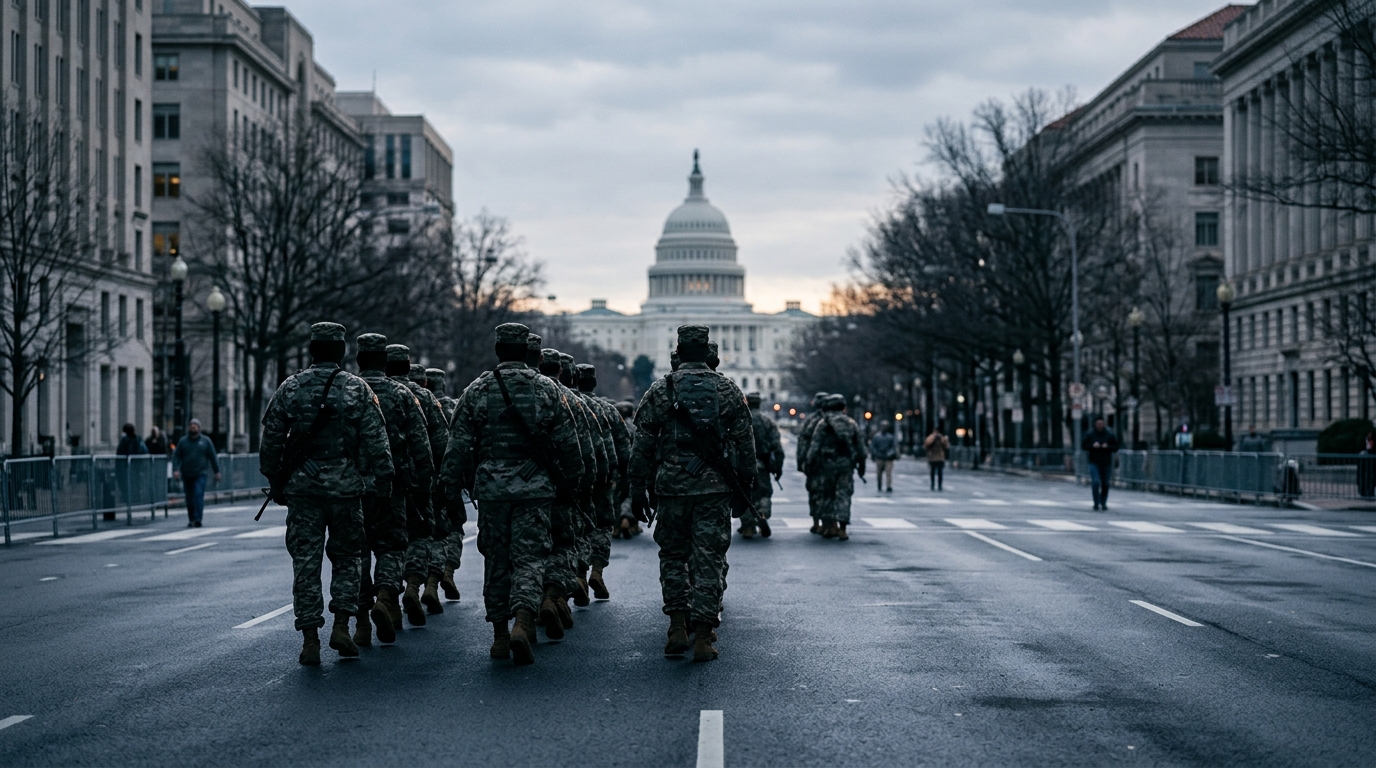
The National Guard deployment in Washington, announced on August 11, 2025, as a temporary reinforcement, will extend until January 2029, according to an AP report published on August 10, 2026. The Department of Defense estimates the cost at around $1.4 billion.
A year after the announcement, what was presented as a temporary reinforcement has become a routine military presence: as of August 4, more than 4,600 personnel from the District of Columbia and 24 states and territories remained deployed alongside federal agents, according to the AP report and coverage by The Washington Times. Residents and local officials question the need for the troops, while a lawsuit challenging the deployment remains pending. Washington's structure as a federal district, overseen by Congress, allows the federal government to directly control its National Guard. The case opens an institutional comparison for Mexico, whose National Guard has been undergoing a process of institutionalization under military command since 2024, with the same question about the temporariness of armed forces in internal security.
The figures give a sense of the mission's scale: the District's prosecutor's office attributes more than 13,000 arrests to the reinforcement. Metropolitan Police data show that overall crime fell 20% through August 7 compared with the same period in 2025, with a 32% drop in homicides, from 97 to 66. How much of that decline corresponds to the deployment or to prior local efforts remains an open debate, AP notes. Small groups of armed personnel patrol tourist areas and neighborhoods where violent crime is uncommon, a routine that part of the residents support and another part question. A lawsuit challenging the extension remains pending in the courts.
The deployment will be a test for the new local officials who take office after the November 2026 midterm elections, among them the winner of the Democratic primary for mayor of Washington. With the extension in effect until January 2029, the troop presence in the capital will also span the 2028 presidential election, keeping the temporariness of the mission an open question.
This article was written with the assistance of artificial intelligence based on verified sources and reviewed by a human editor before publication.