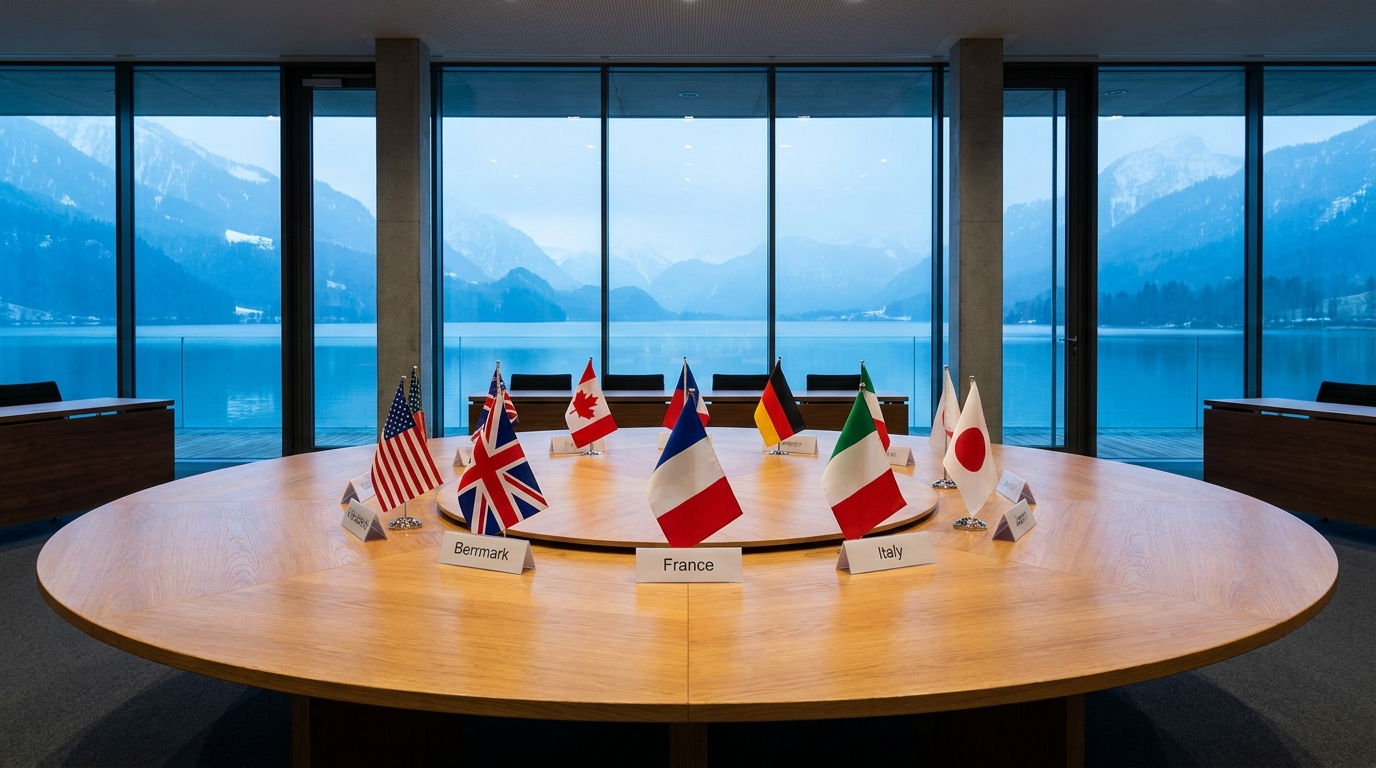
The G7 summit in Évian-les-Bains closes this Tuesday without a single final communiqué, its agenda fragmented into thematic documents by area. The signal goes beyond diplomatic style: the bloc is acknowledging that on critical minerals, artificial intelligence, and trade, its priorities are beginning to diverge at the operational level, making the bilateral deals struck on the sidelines just as important to read as the official texts.
The summit, which opened on June 15 under the French presidency, brings together the United States, the United Kingdom, Canada, France, Germany, Italy, Japan, and the European Union, alongside invited leaders from India, Ukraine, Egypt, the United Arab Emirates, and Qatar. According to [India News Network](https://www.indianewsnetwork.com/en/g7-summit-2026-commences-evian-global-leaders-agenda-20260616), the opening session focused on three operational axes: the U.S.-Iran agreement, a critical minerals supply chain free from exclusive Chinese dependence, and the governance of artificial intelligence. For Latin America, the implication is direct: the G7 sets global rules on technology, energy, and trade that then translate into the bilateral frameworks within which the region operates.
Before the summit, Canada and France signed a general information security agreement opening the exchange of classified data in defense, space, AI, and aerospace. Prime Minister [Mark Carney](https://www.theglobeandmail.com/canada/article-carney-in-france-meeting-macron-g7-summit/) arrived in Évian committed to expanding Canadian access to the European SAFE program, valued at 150 billion euros, and with an explicit agenda on AI standards and the protection of children's data. At the critical minerals table, France's proposal for a Permanent Secretariat, designed to give continuity to the 2025 Kananaskis Action Plan, was put on hold after the U.S. delegation expressed a preference for fast bilateral agreements over fixed multilateral structures.
The summit closes with area-specific declarations rather than a single text, and the next steps will be set by the bilateral deals on rare earths, semiconductors, and energy signed on the margins of Évian. Those agreements will define the regulatory floor that Latin American value chains will face in the second half of the year, particularly in heavy minerals and associated manufacturing processes.
Fuentes:
- https://www.indianewsnetwork.com/en/g7-summit-2026-commences-evian-global-leaders-agenda-20260616
- https://www.theglobeandmail.com/canada/article-carney-in-france-meeting-macron-g7-summit/