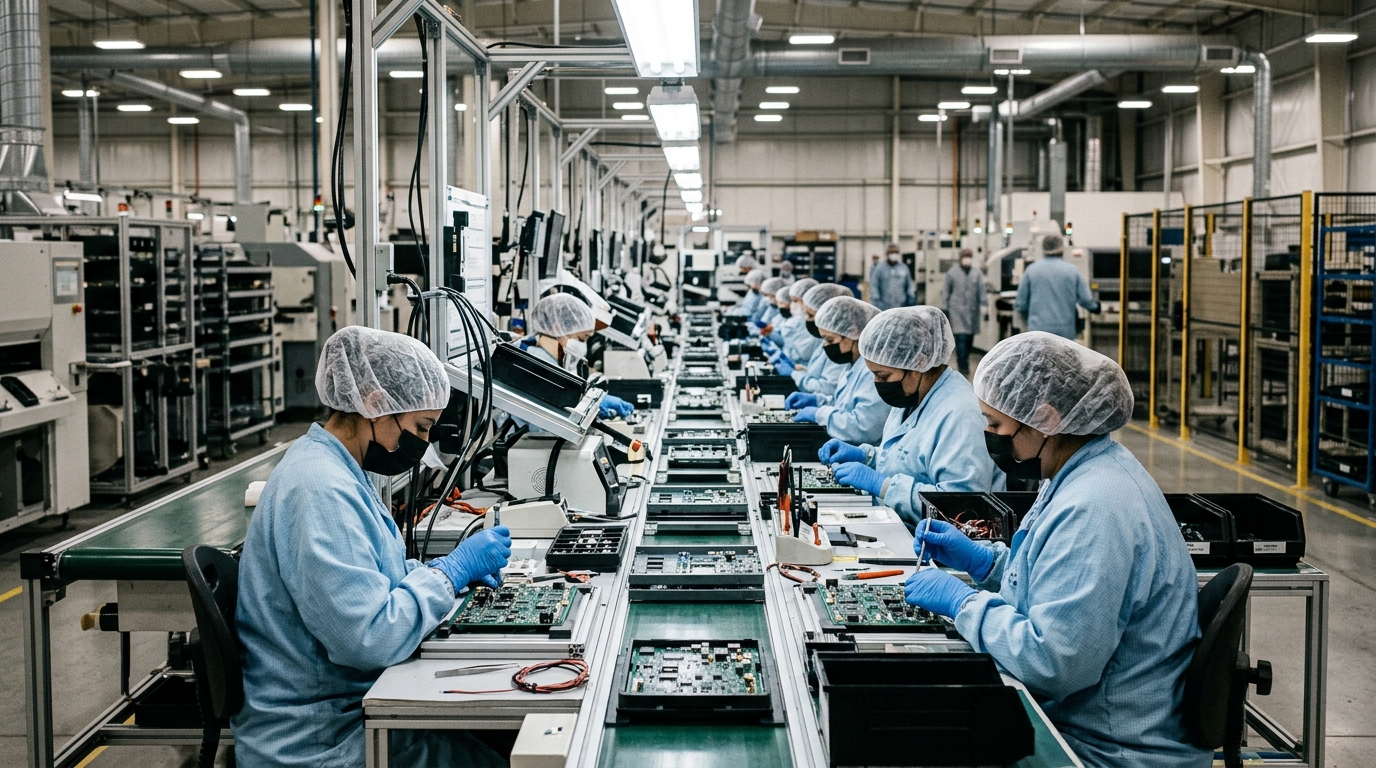
Chihuahua and Jalisco accounted for 79.4% of Mexico's technology exports in the first quarter of 2026, with Chihuahua contributing 52% and Jalisco 27.4%, according to an analysis published on August 5 by Expansión based on data from INEGI's State Economic Activity Quarterly Indicator (ITAEE). The technology sector represented 34% of Mexico's total exports during the period, a historically high share that positions both states as the country's highest-value-added export core.
The analysis reveals a macroeconomic paradox that Expansión's report underscores. Despite leading technology exports, both states recorded economic contraction in the same quarter: Chihuahua fell 1.8% quarter-on-quarter and 0.9% year-on-year, while Jalisco declined 0.8% quarterly and 1.1% year-on-year. Specialists attribute this divergence to the enclave nature of the export industry, whose linkages with the domestic market and local employment are limited. Export clusters generate foreign exchange without necessarily stimulating the state's aggregate economic activity.
The productive specialization driving this concentration creates short-term efficiencies, but also exposes the country to structural risks. Any disruption in the global semiconductor supply chain or in demand for electronic manufacturing in the United States affects Chihuahua and Jalisco disproportionately. The USMCA has been the central catalyst of this specialization, incentivizing the relocation of Asian-origin manufacturing toward the border industrial corridor and the Bajío corridor, with Guadalajara as the principal node of the latter.
The takeaway for national industrial policy is that nearshoring, celebrated between 2023 and 2024 as a historic opportunity for Mexico, is showing its structural limits in 2026: benefits accumulate in a handful of states and spillover to other regions is advancing slowly. States such as Guanajuato, Nuevo León, and San Luis Potosí are emerging as the next nodes of expansion, but their share remains marginal relative to the dominant pair. The public-policy challenge is to design instruments that reduce concentration vulnerability without discouraging the investment that sustains current export leadership.
This article was drafted with artificial intelligence assistance from verified sources and reviewed by a human editor before publication.