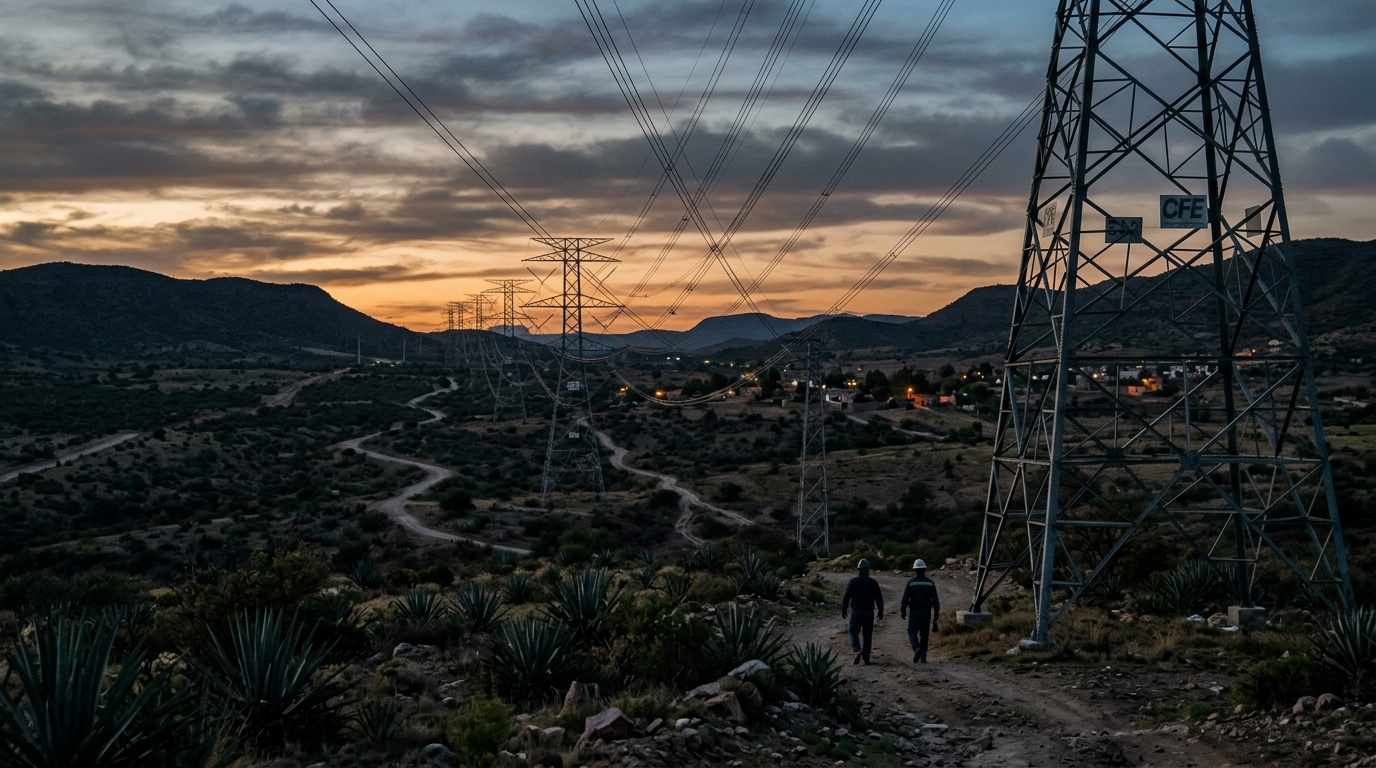
Mexico's Comisión Federal de Electricidad (CFE) published its medium-term plan on August 26, outlining roughly 651,000 million pesos in investment to expand generation, transmission, and distribution capacity through 2030. This marks the first time the utility has presented a fully integrated program of this scope, replacing its previous business plan.
The Programa de Desarrollo CFE 2026-2030 responds to projected growth in electricity demand and details targets, financing sources, and operational projections. More than half of the earmarked resources rely on off-balance-sheet structures, primarily mixed-financing mechanisms to develop renewable power plants. According to La Crónica de Hoy, the plan calls for raising CFE's share of national generation from 43% to 53%, and increasing the weight of renewables within its own generation portfolio from 21% to 34%. For Mexico, the plan carries strategic weight because grid expansion is a prerequisite for sectors with rising energy demand, including advanced manufacturing and data centers.
On the generation side, the program includes 52 projects to add 18,597 megawatts of new capacity, at an estimated investment of 467,300 million pesos. Of that new capacity, 15,203 MW corresponds to renewable and emissions-free technologies, representing 82% of planned additions and the largest renewable build-out in CFE's history, according to Forbes México. For transmission, roughly 132,000 million pesos are earmarked to add 7,545 kilometers of lines. Distribution receives approximately 52,000 million pesos, covering 97 new substations and the expansion of 95 existing ones. CFE plans to finance the program through its own resources, market instruments, and mechanisms such as Fibra E for certain transmission projects. Including 20 legacy projects inherited from the previous administration, total investment rises to approximately 676,000 million pesos, according to Forbes México.
The program sets a clear reference point for the sector: grid expansion through 2030 will be led by CFE, financed through a mixed model, with renewables climbing from 21% to 34% of its generation mix. Investors and energy-intensive sectors now have on the table the figures, timelines, and funding sources they need to plan accordingly.
This article was produced with artificial-intelligence assistance from verified sources and reviewed by a human editor before publication.