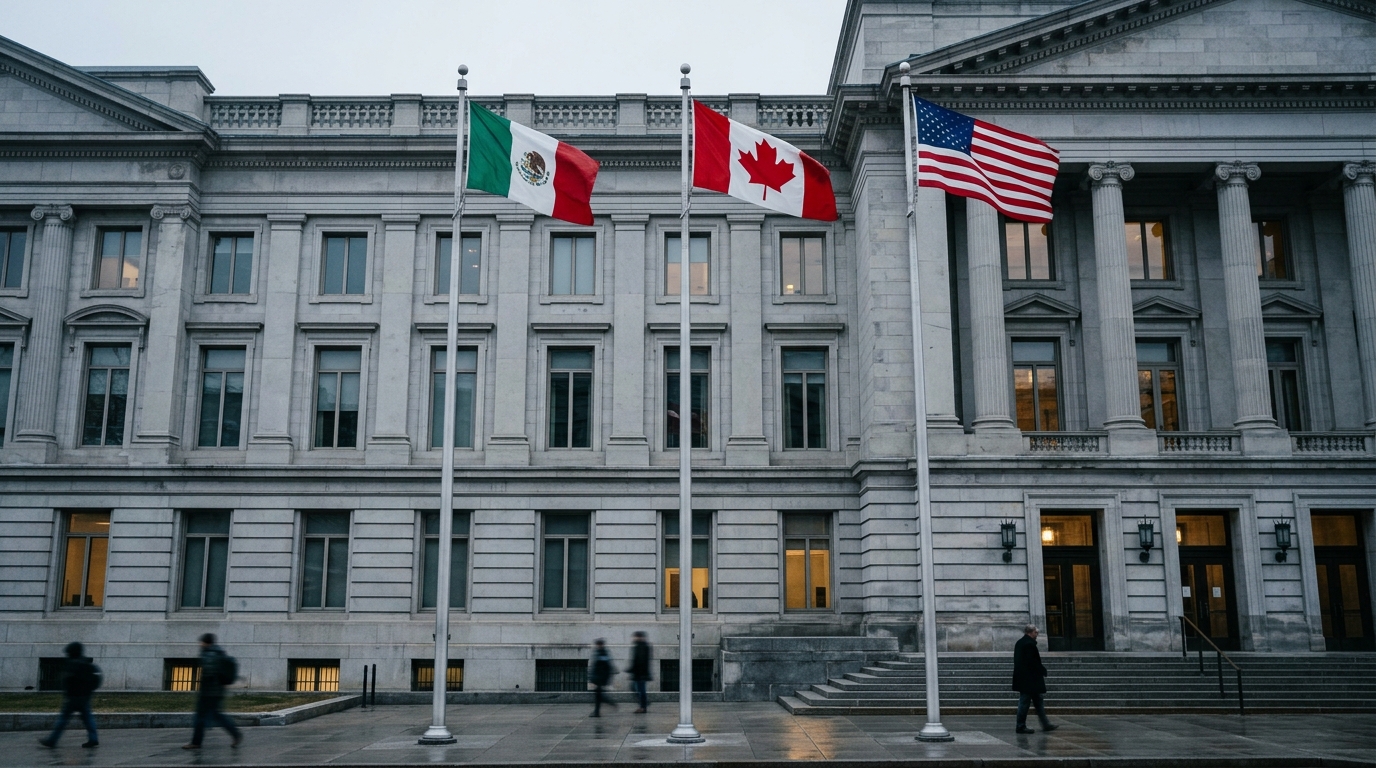
Canada and the United States canceled their trade negotiations and imposed mutual tariffs of up to 50% on August 22, 2026, according to El CEO and Expansión. In that landscape, Mexico is advancing separately on its own bilateral round with Washington for the USMCA review.
The United States-Mexico-Canada Agreement (USMCA) remains in force until 2036, but it has been subject to annual reviews since July 1, when Washington did not accept extending it by 16 more years; El CEO describes that scenario as the agreement's "zombie mode." The rupture with Canada adds pressure to an environment that was already carrying investor caution. Expansión reports that the dispute adds uncertainty to the review and that Moody's Ratings expects the treaty to survive, though with parallel bilateral agreements, sectoral concessions, and different conditions for each partner. Eurasia Group puts at 60% the probability that Mexico and Canada will reach separate agreements with the United States, the most viable of three scenarios the firm outlines for North American trade.
On August 22, Washington imposed 50% tariffs on approximately $20 billion in Canadian products, and Ottawa responded with counter-tariffs, according to Expansión. Fitch Ratings sized the effect of a 50% tariff on Canadian automobiles at close to $45 billion in US imports of cars and auto parts; Canada accounts for 13% of those purchases and Mexico 37%. In any case, integration limits the effect: around 80% of US imports from Canada and Mexico comply with the treaty's rules, according to Moody's. The uncertainty is already reflected in investment: Mexico received $654 million in new investments between April and June, versus $1,155 million in the same period of 2025, according to data from the Ministry of Economy and the Bank of Mexico cited by El CEO.
Mexico maintains bilateral talks with Washington and is preparing a fourth round for September, according to Expansión, while Oxford Economics ranks the country as the agreement's most exposed partner. The pattern of annual reviews and separate agreements is the signal to follow: its outcome will define whether North American trade operates under a trinational framework or under distinct bilateral understandings.
This article was written with the assistance of artificial intelligence based on verified sources and reviewed by a human editor before publication.